Environmental damage before conflicts.

The environmental impact of wars begins long before they do. Building and sustaining military forces consumes vast quantities of resources. These might be common metals or rare earth elements and critical minerals, water or hydrocarbons. Control over militarily relevant critical minerals is becoming an increasingly important strategic consideration for militaries, as evidenced by policies towards Ukraine and the DRC. Maintaining military readiness means training, and training consumes resources. Military vehicles, aircraft, vessels, buildings and infrastructure all require energy, and more often than not that energy is oil, and energy efficiency is low. The CO2 emissions of the largest militaries are greater than many of the world’s countries combined. We estimate that militaries are responsible for 5.5% of all greenhouse gas emissions globally, however military emissions reporting to the UN Framework Convention on Climate Change is poor.
Militaries also need large areas of land and sea, whether for bases and facilities, or for testing and training. Military lands are believed to cover between 1-6% of the global land surface. In many cases these are ecologically important areas. While excluding public development from these areas can benefit biodiversity, the question of whether they could be better managed as civil protected areas is rarely discussed. Military training creates emissions, disruption to landscapes and terrestrial and marine habitats, and creates chemical and noise pollution from the use of weapons, aircraft and vehicles.
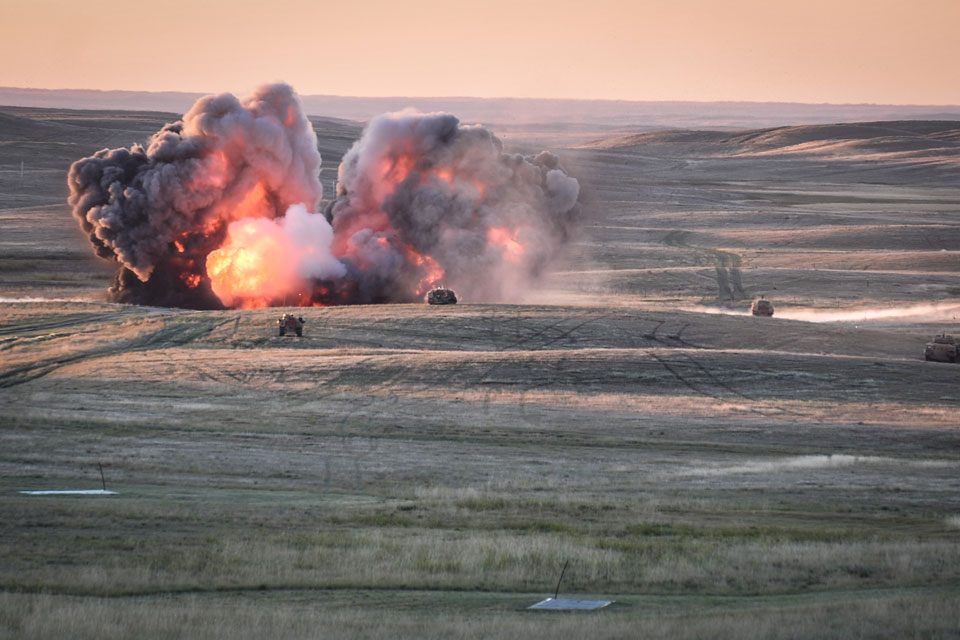
A UK battle group training on the British Army Training Area Suffield (BATUS), Alberta Canada. Much of what we know about the potential health and environmental risks from the residues of weapons come from training ranges, with very little data from conflict contexts. Now commonly used explosives are under increasing scrutiny thanks to civil chemicals legislation. Credit: Ministry of Defence
Sustaining and renewing military equipment and materiel means ongoing disposal costs, with implications for the environment. It is not just the most hazardous nuclear and chemical weapons that create environmental problems throughout their lifecycle. The same is also true for conventional weapons, particularly where they are disposed of through open burning or detonation. Historically, vast quantities of surplus munitions were also dumped at sea.
A history of weak environmental oversight has left many countries with serious environmental legacies linked to military pollution, with impacts on public health and vast costs for environmental remediation. These continue to grow as emerging pollutants like PFAS are identified – while attention has mostly focused on PFAS pollution from firefighting foams at military airfields, there is increasing awareness that they are also in use in many conventional munitions. These legacies are also a problem around overseas bases where one-sided agreements with host nations can reduce environmental oversight.
Indirectly, high levels of military spending diverts resources away from solving environmental problems and away from sustainable development. International tensions stoked by high levels of military spending also reduce opportunities for international cooperation on global environmental threats, such as the climate emergency. It is also important to consider how security policies and militarism are tailored to ensuring access to, and control of, natural resources like oil, gas, water and metals.


Comments
Post a Comment